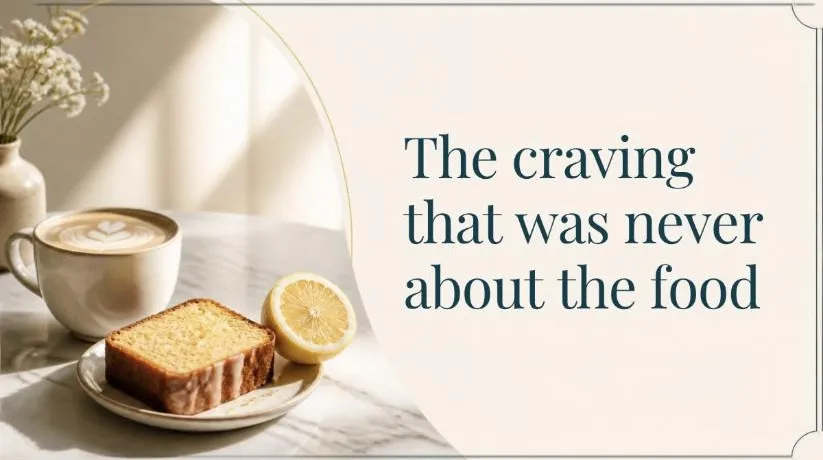
The Craving That Was Never About the Food
You know what to eat. You could teach a class on it. You’ve tried the plans, the rules, the apps and the Monday-morning fresh starts.
And still, at 3 p.m., or after a long day, or on Friday night, something takes over.
The sugar. The glass of wine. The scrolling. The “just one more.” You tell yourself it’s the last time, and part of you already knows it isn’t.
If you’re disciplined everywhere else in your life, this one can be maddening. Why can you run a business, raise a family and train for a race, but not walk past the pastry case?
Because you’re not fighting a food. You’re fighting a feeling.
In my first article in this series, I described the Safety Gap: the space between knowing what to do and feeling safe enough to do it. With cravings, it works in a sneaky way. Your subconscious isn’t blocking something good. It’s chasing something that once felt good.
Why Does Willpower Keep Losing?
You probably know Ivan Pavlov’s famous experiment. Every time he fed his dogs, he rang a bell. Before long, the dogs salivated at the sound of the bell alone. No food required.
That’s a conditioned response, and you have hundreds of them. Most are useful. A few run your life.
Here’s what makes cravings so hard to beat: your subconscious sees pain as a threat, but it doesn’t see pleasure as one. So it never sounds the alarm. Instead, it pushes you toward whatever once delivered comfort, connection or relief, and it keeps pushing long after that comfort stopped serving you.
That’s why willpower loses. Willpower argues with the food. But the craving was never about the food. It’s about what the food meant the first time it soothed you.
What Is a Craving Really Asking For?
Most compulsions are comfort substitutes. At some point, usually in childhood, something sweet, soothing or numbing stood in for something you needed and couldn’t get: attention, safety, reassurance, love.
It worked. It helped you through. That’s why your subconscious holds onto it so tightly.
So the question isn’t “How do I stop eating sugar?” It’s “What is the sugar giving me?” Once you know that, you can stop fighting the habit and start releasing the reason for it.
What Happens When the Real Need Is Found?
A woman I worked with, I’ll call her Nadia, had what she called a “sweet tooth.” It was far more than that.
Every morning she’d stand in line at Starbucks, repeating in her head: Just order the coffee and leave. Just the coffee. By the time she reached the counter, she’d ordered the coffee and a slice of lemon loaf. Then she’d leave conflicted, promising herself, “Just this once. Next time, just the coffee.” Next time never came.
She watched friends eat one or two candies and say, “Oh, that’s enough for me,” and wondered why she could never feel that way. She hid her treats. She felt ashamed. She told me it felt as if the cravings were something that had latched onto her and controlled her thoughts.
When we followed the craving back, it led to a moment when she was seven. Her mother had separated for a while from her stepfather, and she was struggling. Little Nadia felt her mother’s distress, and felt her pull away. A seven-year-old can’t understand that her mother is simply overwhelmed. She concluded: my mother doesn’t love me.
From that moment, sweetness became her substitute. Like a mother’s milk, sugar was comfort and connection. Every piece of lemon loaf was a child reaching for her mom.
Looking at it through adult eyes, she could see the truth. Her mother had been preoccupied with her own pain. It had nothing to do with how much she loved her daughter.
One session. The next time Nadia stood in that Starbucks line, it was as if a switch had been turned off. She said it felt like bumping into an old friend from the past, someone you no longer have a connection to.
The craving never came back. She can even enjoy an occasional sweet treat now, without feeling under its power.
Want to See Your Own Conditioning in Action? Try the Lemon Exercise
This takes one minute, and it will show you how powerful your subconscious is.
- Imagine a big, bright yellow, juicy lemon in front of you. Smell its fresh, sharp citrus scent.
- Slice it in half. The juice squirts out. The scent grows stronger.
- Cut one half again. Now you’re holding a big, fresh quarter of lemon. It smells incredibly sharp and tangy.
- Now bite into it.
Are you salivating?
There’s no lemon. Your body responded anyway, because your subconscious learned long ago what a lemon means. Your cravings work exactly the same way.
Now use that awareness on your own craving. Next time it hits, pause and ask two questions:
- What was the bell? What happened just before? Stress, a lonely evening, a finished task, a difficult call?
- What is it promising me? Comfort, connection, reward, relief, a break?
Those two answers show you the pattern. They don’t show you its source. The source is usually a moment long ago, like Nadia’s at seven, and you can’t think your way back to it. That’s where a craving truly lets go, and finding it goes far faster with guidance.
Who Do You Become When the Craving Lets Go?
When the craving is gone, you don’t need a stricter plan. You simply don’t want it the way you used to. The pastry case is just a pastry case. Friday night is just Friday night.
You stop negotiating with yourself. You stop hiding. Your energy stops going into the fight, and goes into your life instead.
You become someone who enjoys a treat, rather than someone a treat controls. That’s what freedom tastes like!
Ready to Master Clearing Your Subconscious Protectors, Quickly and Easily?
Your subconscious protectors kept you safe once. Now they’re driving the cravings willpower can’t beat.
Every year a block stays in place has a price. Money you don’t earn. Love you don’t let in. Health you don’t protect. And all the energy you spend pushing against yourself, energy you could be using to enjoy your life. When your career, your love life or your health is on the line, how many more years are you willing to lose? The weekend is a one-time investment. Staying stuck costs you every year, and it never sends you an invoice.
At the Breakthrough Intensive on November 21–22, you’ll learn to find and clear your subconscious protectors quickly and easily. You’ll clear your own blocks with a partner and my guidance, and leave able to use the method on your own for life.
You’ll walk out on Sunday night feeling lighter and sharper, able to make things happen without the invisible inner barrier.
Join us in person in Toronto (limited to 20 people) or online from anywhere, with a partner to work with.
Learn More About the Breakthrough Intensive →
Questions first? Reach my Success Team at success@drlisejanelle.com or 1-416-SUCCESS (782-2377).
To your love,
Dr. Lise
Dr. Lise Janelle is a peak performance coach and the creator of the Heart Freedom Method™. She has been doing this work since 1989, has guided more than 126,000 coaching sessions, and is the co-author, with Jack Canfield, of the upcoming book Unstuck.


